How to Fix a Clogged Drain Yourself — A 5-Step DIY Guide
Quick Summary — Most clogged drains are caused by hair, grease build-up, and sediment inside the pipe. You can fix it yourself in 5 steps: (1) Locate the blockage, (2) Open the pipe cover or unscrew the fitting under the sink, (3) Remove the blockage, (4) Flush the pipe clean, (5) Reassemble and test the water flow. If multiple drains are clogged at once, water is seeping through floors or walls, or the DIY approach doesn't work — call a professional to inspect the plumbing system, because the problem may be hidden in the main line.
A clogged drain is a problem almost every home encounters at some point. Water pools in the sink, drains slowly, or an unpleasant smell wafts up from below. Many homeowners immediately call a plumber — but in reality, small issues like this can often be handled in just a few steps.
In this article, the Ballang Intergroup team walks you through a step-by-step method to fix a clogged drain yourself, along with a clear signal for when you should leave it to a professional instead.
Why Do Drains Get Clogged?
Before you start fixing the problem, it helps to understand what causes it — because knowing the source lets you fix it at the root and prevent it from happening again.
Most drain clogs come from:
- Hair build-up in bathroom drains
- Grease and food scraps in kitchen sinks
- Soap scum and mineral sediment that solidifies inside the pipe
- Foreign objects that accidentally fall in
As these accumulate over time, the water channel narrows more and more — until, eventually, water can no longer flow freely.
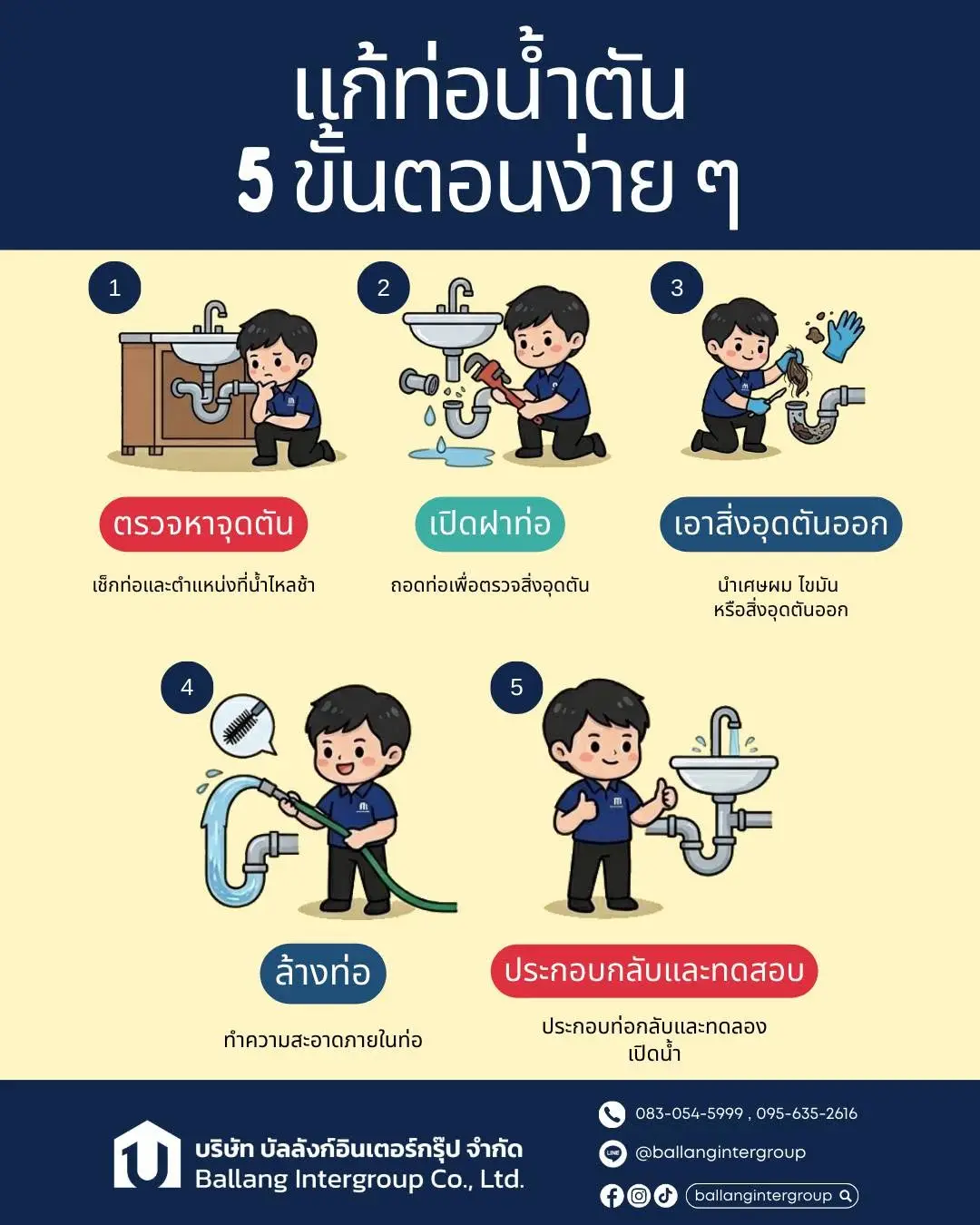
5 Steps to Fix a Clogged Drain Yourself
Step 1: Locate the Blockage
Start by observing where the water is draining slowly or blocked. Turn on the tap and see how slowly it drains — and whether it's only at one spot or across multiple drains at the same time.
If only a single sink is clogged, the problem is usually confined to that section of pipe. But if multiple drains are clogged at once, the issue may be in the main line or shared drainage system. Identifying the location clearly from the start saves you from unnecessarily opening up every fixture.
Step 2: Open the Pipe
Once you've identified the spot, unscrew the pipe cover or the fitting under the sink (known as the P-trap or U-trap — the curved fitting designed to hold water and block odours).
Before you unscrew it, don't forget to place a container or bucket underneath — there will definitely be trapped water inside the pipe that will spill out. Turn the fitting loose slowly by hand or with a wrench. Don't force it — you may crack the fitting or damage the threads.
Step 3: Remove the Blockage
This is the heart of the fix. Pull out all the hair, grease, or solidified debris that's causing the blockage. You can use a wire hook, a stick, or pull it out directly with gloves on.
If the clog is deeper in the pipe and you can't reach it by hand, use a plumbing snake (a spring-wire tool designed to clear pipes) — insert it and rotate to pull the blockage out. Take your time until you're sure nothing is left inside.
Step 4: Flush the Pipe
After the blockage is out, clean the inside of the pipe to wash away any residue still clinging to the walls. Use high-pressure water or run water forcefully through to flush out anything remaining.
For sticky grease build-up, you can use a mixture of hot water, baking soda, and vinegar to help dissolve the deposit. This step is critical — it ensures the pipe is fully clear, not just temporarily opened up.
Step 5: Reassemble and Test
Once the pipe is clean, reattach the fitting and cover securely. Check that the threads and rubber seals are seated correctly. Then turn the tap on and see whether the water flows freely and whether there are any leaks around the joints.
If the water flows fast and there are no drips — you're done.
Long-Term Tips to Prevent Clogs
Fixing the problem is good, but prevention is even better. Try these habits:
Install drain screens to catch hair and food scraps at every drain opening
Never pour hot oil or grease directly into the sink — it hardens inside the pipe
Pour hot water down the drain once a week to flush grease before it builds up
These small habits extend the life of your home's plumbing system significantly.
When Should You Call a Professional?

The steps above work well for minor clogs that you can handle yourself. But some situations should be left to a specialist:
- Multiple drains clogged simultaneously — a sign of a main-line problem
- Water seeping through the floor or walls
- Strong, persistent bad smells
In these cases, there may be hidden issues in the plumbing system that require specialised tools and experience. Forcing a DIY fix can damage the pipe and end up costing more than a professional job would have.
At Ballang Intergroup, we provide one-stop plumbing and home repair services — diagnosing the root cause, fixing it completely in one visit, with a written warranty on every job. Small drain problems that feel annoying? Let a professional team handle them so you can stop worrying.
Frequently Asked Questions
Q: Do you take on drain-unclogging work in Bangkok and surrounding provinces?
A: Yes. Our team serves Bangkok and its surrounding provinces — including Sukhumvit, Rama 9, Ratchada, Lat Phrao, Bang Na, Sathorn, Nonthaburi, Pak Kret, Rangsit, and Samut Prakan.
Q: Do I need to notify the building management for plumbing work in a condo?
A: Yes, you should. Most condos have rules about work hours and contractor access. If the job involves opening ceilings or touching the building's shared plumbing, notifying the building management (juristic person) before starting is essential. Our team can help coordinate this for you.
Q: Are the drain cleaners sold in stores safe to use?
A: They work for minor clogs, but shouldn't be used frequently or repeatedly. Some chemicals corrode PVC pipes and rubber seals, causing them to deteriorate faster. If you've already used one and the problem hasn't improved, the issue is deeper than a chemical cleaner can handle.
Q: Can I send photos for an initial estimate?
A: Yes. Send us photos of the site or a short video via LINE — our team can provide an initial assessment and recommend an approach before you commit.
Q: How long does drain-unclogging work take?
A: Standard clog jobs usually finish within a single day. However, if we need to inspect the full plumbing line or open walls, the timeline will depend on the scope of work and the actual site conditions.
Q: Why does my drain keep clogging again?
A: Usually because the fix only addressed the end of the pipe without properly cleaning the residue coating the pipe walls. Or there's a structural issue — such as pipes that weren't installed with the correct slope, so water doesn't drain properly and sediment keeps accumulating. In these cases, you need a professional to inspect the root cause.
Get in Touch Today
If you're dealing with a clogged drain, slow drainage, or bad smells coming back up from the pipes, send photos of the site to the Ballang Intergroup team for an initial assessment. Our team will recommend the right approach for the site conditions and your budget.
Call: 083-054-5999 / 095-635-2616 LINE: @ballangintergroup Website: ballangintergroup.com
Services: Home & Condo Repair and Renovation / Plumbing & Electrical / Built-In Furniture / Interior Design Property Types: Single-Family Homes · Townhomes · Condos · Commercial Buildings — across Bangkok and surrounding provinces